mercredi 28 mars 2012

IBM Launches Smarter Analytics: Ready to Get Smart?

IBM this week launched a business initiative called Smarter Analytics to showcase the value of its technology and professional services in this area. The event, led by Steve Mills, head of IBM’s software and systems business, highlighted the company’s ability to solve analytic challenges at all levels of complexity. At the event IBM highlighted Watson, the learning and expert systems technology that in 2011 beat human champions on Jeopardy. IBM also introduced a collection of case studies exemplifying its customers’ success. 
The event built upon the launch earlier this month of IBM Cognos Insight, a new $500 desktop application. As my colleague David Menninger assessed, the product provides personal analytics that users can share and connect to departmental and enterprise analytics if needed. Most interesting is the ability to drag and drop spreadsheets into the product, where Insight discovers and adapts them for further analysis within its analytic environment. The product can also perform what-if and scenario-based analytic capabilities that distinguish it from other business intelligence software in the market. I like that IBM provides the online Internet IBM Insight Community where users can access examples and templates to see what is possible. Those who need more intense modeling and planning can use IBM Cognos TM1 or expand further with IBM Cognos Enterprise
I was intrigued enough to look to install the software and try it on my own computer. I looked for a trial version of the product, but unlike Microsoft Office and other products that expire after an evaluation period, you have to purchase IBM Cognos Insight even if you only want to test it. IBM needs to allow a trial period if it wants to get more people to experience what appears to be a promising advance in personal analytics. I was not willing to buy it just to evaluate.
IBM has also enhanced the predictive analytics technologies it acquired through SPSS. They now integrate the flow of analytic tasks to support more forward-looking capabilities. In addition, IBM highlighted its advances in decision management, which uses analytics and rules to establish policies and direct actions. This set of capabilities is now available in cloud-based software as a service which is easier to configure and use. 
To make their analytics smarter, organizations need improved efficiency and a foundation of accurate, consistent data. Many organizations realize they need to revise their architecture and perhaps select a new technology supplier for information management. CIOs are looking for ways to be more effective in managing data and reducing projected costs in doing so. IBM has shifted its dialogue toward managing big data, which we have already benchmarked, to give CIOs another popular choice to examine further. As David Menninger rightfully points out, big data is more than just Hadoop and our benchmark research in Hadoop found that it is more complimentary than just replacing existing data warehouse and RDBMS efforts.  Companies should be concerned with  perfecting their methods and processes for managing and utilizing information assets on all scales. To cover the entire field, we continue to conduct research on information management, while our 2012 research agenda highlights big data and overall importance of a portfolio of technologies and processes.


Read more @
http://smartdatacollective.com/mark-smith/48622/ibm-launches-smarter-analytics-ready-get-smart 

Mark Smith – CEO & Chief Research Officer

Applying Watson technology for personalized cancer care

(Credit: IBM)
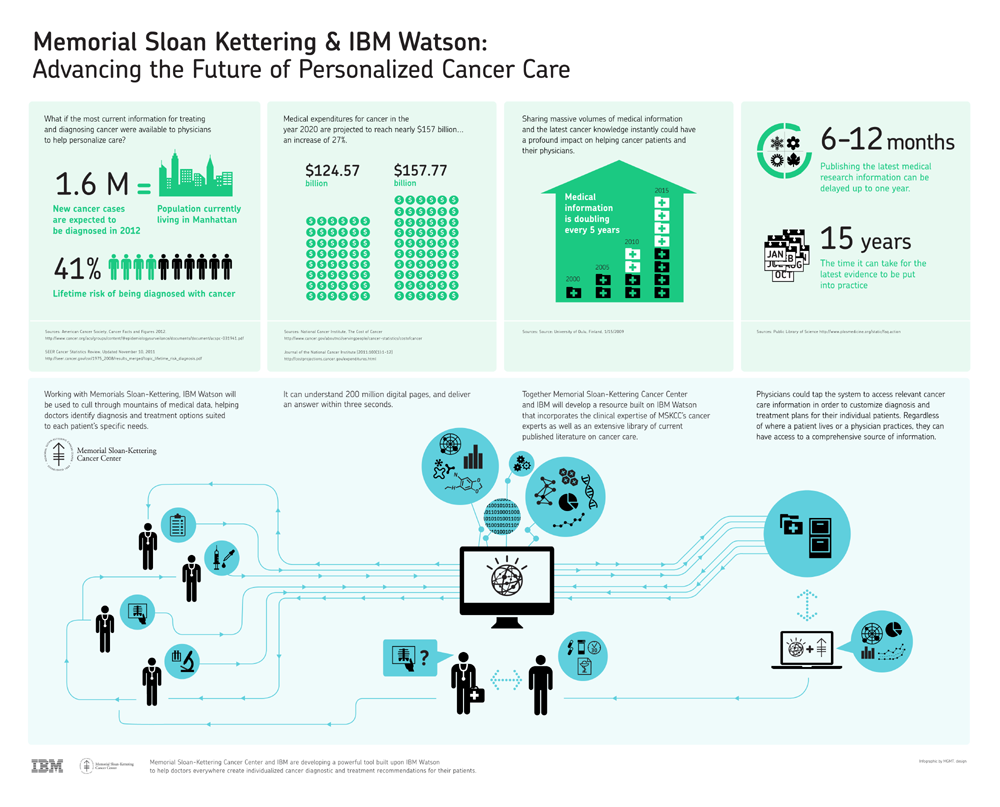
Memorial Sloan-Kettering Cancer Center (MSKCC) and IBM have announced an agreement to collaborate on the development of a powerful tool built upon IBM Watson to provide medical professionals with improved access to current and comprehensive cancer data and practices.
The resulting decision support tool will help doctors everywhere create individualized cancer diagnostic and treatment recommendations for their patients based on current evidence.
Instant diagnostic and treatment options
The idea is to combine the computational power of IBM Watson and its natural language processing ability with MSKCC’s clinical knowledge, existing molecular and genomic data, and a vast repository of cancer case histories to create an outcome- and evidence-based decision support system.
The goal: give oncologists located anywhere the ability to obtain detailed diagnostic and treatment options based on updated research that will help them decide how best to care for an individual patient.
The IBM Watson system can interpret queries in natural language and uses statistical analysis, advanced analytics, and a powerful array of processors to search millions of pages in seconds and deliver evidence-based, statistically ranked responses (credit: IBM)
MSKCC’s world-renowned oncologists will assist in developing IBM Watson to use a patient’s medical information and synthesize a vast array of continuously updated and vetted treatment guidelines, published research and insights gleaned from the deep experience of MSKCC clinicians to provide an individualized recommendation to physicians. The tool will also provide users with a detailed record of the data and evidence used to reach the recommendations.
Managing increasing complexity 
Source: University of Oulu, Finland 1/15/2009 (credit: IBM)
The need for such an advanced technology arises from the steadily increasing complexity of oncology treatment.
Cancers are the second most common cause of death in the U.S., second only to heart disease, and the American Cancer Society projects that 1.6 million new cancer cases will be diagnosed in the U.S. this year, with outcomes varying widely across the country.
Cancer is not one disease but some hundreds of sub-types, each with a different genetic fingerprint.
Significant discoveries in molecular biology and genetics in the past two decades have delivered new insights into cancer biology and strategies for targeting specific molecular alterations in tumors, but these advances have also ratcheted up the complexity of diagnosing and treating each case.
Revolutionizing access to information
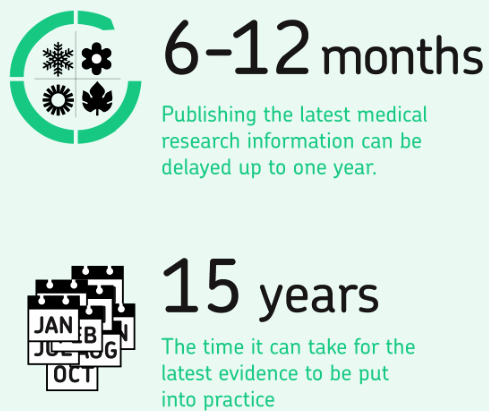
Source: Public Library of Science (credit: IBM)
Oncologists and physicians who do not specialize in specific sub-types of cancer face a significant challenge in keeping up with the magnitude of rapidly changing information.
“The combination of transformational technologies found in Watson with our cancer analytics and decision-making process has the potential to revolutionize the accessibility of information for the treatment of cancer in communities across the country and around the world,” said MSKCC President and CEO Craig B. Thompson.
“Memorial Sloan-Kettering’s evidence-based clinical approach, scientific acumen, and vast database make it the ideal partner in this ambitious project,” said Dr. Martin Kohn, chief medical scientist, IBM. “Cancer care is profoundly complex with continuous clinical and scientific advancements to consider. This field of clinical information, given its importance on both a human and economic level, is exactly the type of grand challenge IBM Watson can help address.”
“This comprehensive, evidence-based approach will profoundly enhance cancer care by accelerating the dissemination of practice-changing research at an unprecedented pace,” said Dr. Mark G. Kris, Chief, Thoracic Oncology Service at MSKCC and one of the clinicians leading the development effort. He noted that 85 percent of patients with cancer are not treated at specialized medical centers and it can take years for the latest developments in oncology to reach all practice settings.
Development work is already underway for the first applications, which include lung, breast and prostate cancers. The objective is to begin piloting the solutions to a select group of oncologists in late 2012, with wider distribution planned for late 2013.

http://www.kurzweilai.net/applying-watson-technology-for-personalized-cancer-care

vendredi 23 mars 2012

Watson lends a helping hand to cancer research, partners with Memorial Sloan-Kettering

Supercomputers at the forefront of medical practice? The notion is by no means a stretch of the imagination. Yet, research of this kind mostly goes unnoticed -- that is, unless the computational wizardry handholding these advancements belongs to Jeopardy!'s AI king. That's right, Watson, IBM's bold-face named powerhouse of silicon wizardry, will be made available as a development tool for oncologists at Memorial Sloan-Kettering to deliver "individualized cancer diagnostic and treatment recommendations" derived from the center's case note database. Drawing upon that raw processing power, field practitioners will purportedly have access to a wealth of the latest therapeutic advances which would, normally, take too long to spread outside of specialized facilities. The agreement is not the first of its kind, as this time last year IBM had announced a similar partnership with Columbia University, although no further news has come from that union. MSKCC, for its part, does have concrete plans to move its small pilot program forward, with a target launch set for later this year and plans to expand the project's reach by end of 2013. Jump past the break for the official presser.


mardi 20 mars 2012

Nanotechnologie : les images moléculaires d'IBM aident à la miniaturisation

Pour la première fois, des chercheurs d'IBM ont réussi à voir comment une charge éléctrique était distribuée à l'intérieur d'une molécule. C'est une avancée capitale pour la recherche fondamentale au moment où les scientifiques cherchent à miniaturiser des circuits à l'échelle du nanomètre.
Nanotechnologie : les images moléculaires d'IBM aident à la miniaturisation IBM a étudié le comportement de structures moléculaires placées sur des surfaces artificielles. « L'objectif est de rendre ces molécules fonctionnelles dans le futur, pour les utiliser comme des interrupteurs ou des transistors par exemple », a déclaré Fabian Mohn, chercheur chez IBM. Ce sont des techniques de microscopie et d'imagerie avancées qui ont été utilisées pour voir comment se répartissait et se distribuait la charge de liaisons chimiques formées entre atomes et molécules placés sur ces surfaces.

« Cette percée de la recherche est un pas en avant dans la compréhension, le contrôle et le peaufinage des structures moléculaires des systèmes électriques », a déclaré le chercheur. Par exemple, une molécule qui aurait des propriétés intéressantes pour séparer des photons en charges positives et négatives dans chaque direction pourrait faciliter et rendre plus efficace la transformation de la lumière en électricité par les cellules solaires.

Utiliser les recherches pour modifier le graphène

« Cette découverte permet aussi de mieux comprendre l'efficacité d'une structure moléculaire comme interrupteur, diode ou transistor », a déclaré Michael Crommie, professeur de physique à l'Université Berkeley de Californie, et chercheur auprès du Lawrence Berkeley National Laboratory. « Certaines personnes pensent qu'il serait intéressant d'utiliser les molécules comme des blocs de construction pour les systèmes électriques », a déclaré le chercheur qui n'a pas participé à la recherche d'IBM. « L'un des problèmes est de trouver comment organiser les molécules sur ces surfaces pour faire ce que nous voulons qu'elles fassent. Beaucoup de chercheurs travaillent sur le sujet. »

« La technique d'IBM repose sur un outil de diagnostic qui permet aux chercheurs de mieux caractériser les petites structures », a déclaré Michael Crommie. Les molécules sont des assemblages d'atomes ayant des configurations particulières et reliées entre elles par des liaisons chimiques. Elles se comportent différemment selon l'environnement. Les électrons maintiennent les atomes ensemble et donnent aux molécules toutes leurs propriétés. La façon dont les systèmes moléculaires peuvent se comporter est infini. « Les chercheurs aimeraient prédire le comportement moléculaire sur les surfaces et affiner les structures en conséquence », a expliqué l'universitaire. Par exemple, l'outil d'IBM pourrait aider les chercheurs du Lawrence Berkeley National Laboratory à créer des dispositifs de graphène plus efficaces en leur appliquant des modifications au niveau atomique. Michael Crommie voudrait modifier le graphène en ajoutant ou en supprimant une charge, ou encore voir comment le graphène influe sur le comportement d'une molécule.

 IBM a mené ses propres recherches sur le graphène. L'an dernier, l'entreprise a montré un transistor de graphène capable d'exécuter 155 milliards de cycles par seconde, soit 50% plus rapide que les précédents transistors expérimentaux réalisés par les chercheurs d'IBM. On sait que les flux d'électrons sont plus rapides sur les transistors au graphène que les transistors classiques, et permettent des transferts de données plus rapides entre les processeurs.

Cependant, des questions demeurent, notamment pour savoir si les molécules peuvent être utilisées comme base de construction pour les semi-conducteurs. Il est également difficile de prédire la portée des découvertes annoncées par IBM. « Il faudra sans doute des années de recherche et d'expérimentation pour vérifier si les structures moléculaires peuvent se comporter de manière rationnelle dans un environnement de synthèse », a estimé Michael Crommie. « C'est de la recherche fondamentale. Ce n'est pas comme optimiser un processus qui existe déjà. Les chercheurs d'IBM cherchent de nouvelles combinaisons de matériaux qui ne sont pas utilisées dans l'industrie. On est encore loin de la production », a ajouté l'universitaire.

Prochaine étape, des circuits à l'échelle nanométrique

Selon Fabian Mohn d'IBM, la prochaine étape pourrait consister à porter la technique plus loin, pour connecter des molécules ou fixer des molécules sur le métal pour réaliser des circuits à l'échelle nanométrique par exemple. L'objectif ultime d'IBM est de faire progresser la technologie pour fabriquer des dispositifs électroniques. Mais c'est au fur et à mesure des avancées qu'il sera possible de préciser l'orientation de cette recherche. « C'est comme l'informatique quantique. En principe, on pense que ça pourrait être utile. Mais nous n'en sommes pas encore au stade des applications directes », a déclaré le chercheur.

 Article de Jean Elyan avec IDG News Servic
 http://www.lemondeinformatique.fr/actualites/lire-nanotechnologie-les-images-moleculaires-d-ibm-aident-a-la-miniaturisation-47944-page-2.html

Présentation de la première famille de systèmes dotés d'une expertise intégrée

Et si vous aviez toujours un expert à portée de main? 

Une nouvelle ère pour l'informatique
Ne manquez pas la retransmission par Webcast du 11 avril 2012 S'inscrire aujourd'hui
 
Rejoignez-nous le 11 avril 2012, jour de lancement de la nouvelle gamme IBM « Expert Integrated Systems ». Grâce à une intégration poussée de savoir-faire et par une simplification d'usage à tous les niveaux, ces systèmes améliorent radicalement l’équation économique de l'IT. Ils vont non seulement révolutionner les opérations, mais également permettre à toute votre entreprise de bénéficier d'un accès immédiat à nos connaissances issues de plusieurs milliers de déploiements et des millions d'enseignements que nous en avons tirés.

Ces systèmes changent l'équation économique de l'IT. Par une intégration poussée de savoir-faire. Par une simplification d'usage à tous niveaux. Dès leur conception.

Inscrivez-vous dès aujourd'hui à la retransmission de l'événement du lancement via le web organisé par IBM

Soyez l'un des premiers à découvrir l'expertise incorporée dans ces « Expert Integrated Systems ». Et soyez le témoin d’un véritable bouleversement des pratiques traditionnelles de l'informatique.
Inscrivez-vous dès maintenant


jeudi 8 mars 2012

IBM eyes new systems with 'integrated expertise' built in

Summary: IBM on April 11 will “unveil a new era of computing” and a “new family of expert integrated systems,” according to hardware chief Rod Adkins.
NEW YORK — Rod Adkins, senior vice president for IBM Systems and Technology, said Wednesday morning that the company plans to launch a series of systems that will have “integrated expertise” built in.
Speaking at a Wall Street event for customers and prospective customers at Cipriani restaurant in Manhattan, Adkins foreshadowed an April event: on April 11, IBM will “unveil a new era of computing” and a “new family of expert integrated systems,” he said.
In other words, IBM is looking to launch a sequel to its “A Smarter Planet” initiative. IBM has long been trumpeting a new “learning age” for computing. (Sounds like an army of mini Watsons to me.)
Adkins, who talked about intelligence being embedded on every device, said that these new systems will combine IBM’s semiconductor, research and services advances in an integrated system.
“These systems will continue to evolve the notion of smarter computing,” he said.
The company plans to drop further hints leading up to the April launch, according to Adkins. Big Blue has said that it sees Watson’s technology being leveraged in multiple industries. Now it sounds like these systems will be rolling out in a more prepackaged format.

 By | February 15, 2012, 7:51am PST
 http://www.zdnet.com/blog/btl/ibm-eyes-new-systems-with-integrated-expertise-built-in/69531

mercredi 7 mars 2012

IBM au service du Louvre pour le rendre "plus intelligent"

Le géant informatique IBM met sa puissance au service du musée du Louvre, dans le but de l'aider à mieux encore protéger ses oeuvres d'art, économiser l'énergie et rester ouvert à ses millions de visiteurs. (c) Afp
Le géant informatique IBM met sa puissance au service du musée du Louvre, dans le but de l'aider à mieux encore protéger ses oeuvres d'art, économiser l'énergie et rester ouvert à ses millions de visiteurs.
(c) AfpLe géant informatique IBM met sa puissance au service du musée du Louvre, dans le but de l'aider à mieux protéger encore ses oeuvres d'art, économiser l'énergie et rester toute l'année ouvert à ses millions de visiteurs.
Avec des capteurs, des outils d'analyse en temps réel et autres outils connectés à internet, l'idée est de rendre le musée, le plus fréquenté au monde, "plus intelligent".
"Ce n'est pas un travail, c'est une mission", explique à l'AFP un vice-président d'IBM, David Bartlett, surnommé "l'homme qui murmure à l'oreil des bâtiments" pour sa passion pour une meilleure gestion des immeubles.
"Si on écoute un bâtiment de façon holistique, il y a des tas d'occasions d'améliorations", explique-t-il. "Le Louvre me dit qu'il y a tout un réseau complexe de systèmes à l'intérieur de systèmes".
Le Louvre, qui a conclu avec IBM un contrat pluriannuel d'un montant non précisé révélé lundi par le groupe informatique, réalise en moyenne 65.000 travaux de réparation ou de maintenance par an dans ses plus de 60.000 mètres carrés d'espace d'expositions permanentes, qui parfois exigent la fermeture de certaines salles ou galeries.
"Le fait qu'il abrite des milliers d'oeuvres d'art irremplaçables qui doivent être préservées pendant qu'on essaie d'accueillir des millions de visiteurs chaque année, représente une difficulté supplémentaire", souligne le responsable du département de maintenance informatique du musée, Metin Pelit.
Dans le cadre de son initiative "Smarter Buildings" ("des bâtiments plus intelligents") lancée par IBM en février 2010, le groupe new-yorkais a déjà installé son logiciel Maximo pour coordonner les opérations de nettoyage, d'entretien, de chauffage, d'éclairage, et même de verrouillage des plus de 2.500 portes qu'abrite le musée.
"On a beau concevoir la meilleure maison possible en termes d'économies d'énergie, si l'adolescent de la maison laisse la porte ouverte, ça ruine tout", fait valoir M. Bartlett - qui note au passage que le Louvre doit aussi veiller aux questions d'humidité.
Avant le nouveau système d'IBM, le personnel du Louvre s'en remettait aux papiers et formulaires pour gérer l'entretien.
Mais "gérer les visites de réparations, de nettoyage et de maintenance qui permettent de préserver les locaux et les oeuvres d'art, tout en gardant les galeries accessibles, c'est une tâche dantesque", fait valoir Metin Pelit.
"Grâce au logiciel IBM, nous sommes capables de visualiser toute l'infrastructure, et de prendre de meilleures décisions, mieux informées sur la façon et le moment de résoudre un problème, ou d'agir préventivement pour éviter un problème que sinon nous n'aurions pas vu venir".
Des capteurs permettent par exemple de repérer des filtres ayant besoin d'être changés, ou des moteurs en bout de course. Le logiciel tient à jour une liste d'intervenants spécialisés pour réaliser les travaux requis.
Alors que ce partenariat n'en est qu'à ses débuts, IBM affirme avoir déjà permis au Louvre de réaliser 40% d'économies d'énerge dans ses bâtiments anciens.
"Le Louvre est maintenant en mesure d'ouvrir au public quotidiennement la majorité de ses galeries, tout en réduisant ses coûts", selon M. Pelit.
Le programme réalisé par IBM au Louvre est l'un des plus ambitieux de l'initiative "Smarter Buildings", également retenue par l'université Tulane à La Nouvelle-Orléans (sud des Etats-Unis), ou encore par le gigantesque hôtel-casino The Venetian à Las Vegas (ouest des Etats-Unis).

 Créé le 05-03-2012 à 23h31 - Mis à jour le 06-03-2012 à 03h02   
http://tempsreel.nouvelobs.com/societe/20120305.AFP9481/ibm-au-service-du-louvre-pour-le-rendre-plus-intelligent.html

mardi 6 mars 2012

IBM : des progrès de géant dans l’informatique quantique

L’un des laboratoires de recherche de Big Blue annonce avoir accompli des progrès déterminants en vue de la fabrication d’un ordinateur quantique.
C’est le Graal de l’informatique, le mouvement perpétuel, le nirvana de l’octet, la pierre philosophale, l’Alpha et l’Omega et toutes les autres chimères que vous pourrez imaginer, bref cela s’appelle l’ordinateur quantique. Depuis 1981, le prix Nobel de physique Richard Feynmann a mis au défi les scientifiques du monde entier de créer un ordinateur quantique et non plus reposant sur des transistors comme c’est le cas depuis l’invention de l’ordinateur dans les années 40.
La principale différence entre un ordinateur quantique et un ordinateur à transistors est la suivante. Dans le premier cas, l’information est binaire matérialisée par un 0 ou un 1 selon que le courant circule ou non. Le bit est la plus petite représentation que l’on puisse alors trouver. Dans le cas d’un ordinateur quantique, ce même « bit » devenu Qubit (pour quantum bit) peut prendre la valeur 0 ou 1 ou les deux. Dès lors, cela ouvre la voie à des millions d’opérations par seconde et doit pouvoir surpasser en performances tout ce dont sont capables les plus puissants des supercalculateurs.

Maintenir les propriétés quantiques

Le principal problème existant jusqu’à maintenant est de maintenir l’intégrité de ces bits quantiques (qubits), c'est-à-dire de maintenir et de contrôler leur cohérence, ceci étant la seule possibilité pour éviter les erreurs de calcul liés à l’interférence de chaleur, de rayonnement électromagnétique. L’un des principaux travaux des chercheurs du monde en général et d’IBM en particulier est d’allonger la période pendant laquelle les qubits conservent leurs propriétés quantiques.
Pour ce faire, IBM a expérimenté des qubits supraconducteurs en 3 dimensions qui conservent leur état quantiques durant 100 microsecondes, soit 2 à 4 fois plus que les précédents records. Les ingénieurs d’IBM estiment que cette durée est le seuil minimum permettant de mettre en place des systèmes de correction d’erreurs, ce qui ouvre la voie à de nouvelles possibilités dans la construction d’un véritable ordinateur quantique. Outre ces travaux, les chercheurs d’IBM ont également travaillé sur des approches plus « traditionnelles » en deux dimensions qui se sont également révélé prometteuses.


Un rêve accessible

Dans ces conditions, les équipes de Big Blue considèrent désormais que la fabrication d’un ordinateur quantique ne relève plus du fantasme ou du rêve mais qu’il devrait être possible de le réaliser dans les prochaines années même s’il subsiste encore d’immenses défis scientifiques et technologiques. L’un des dirigeants du groupe quantique d’IBM, Matthias Steffen, a déclaré à Venture Beat qu’il pensait pouvoir voir un tel ordinateur de son vivant, lui qui travaille sur ces technologies depuis plus d’une dizaine d’annéesLes résultats des travaux menés par IBM sont présentés cette semaine à Boston à l’occasion de la réunion annuelle de la Société américaine de Physique.

 par Stéphane Larcher, le 28 février 2012 12:51
http://www.linformaticien.com/actualites/id/23769/ibm-des-progres-de-geant-dans-l-informatique-quantique.aspx

lundi 13 février 2012

IBM spins ultrasharp nanomanufacturing tool 100,000X smaller than a pencil tip

The new IBM tip offers lower wear rate than conventional silicon tips and is 100X stronger company claims 


IBM spins ultrasharp nanomanufacturing tool 100,000X smaller than a pencil tip

The new IBM tip offers lower wear rate than conventional silicon tips and is 100X stronger company claims


ibmIBM says it has developed a silicon carbide tip for nanomanufacturing applications that it claims is a thousand times more wear-resistant than current tool bits and 100,000 times smaller than a pencil tip.
IBM scientists say the the new tip can be used to fabricate all manner of bio sensors, for example for managing glucose levels in diabetic patients or monitoring pollution levels in water.
Off the wall: All hail: Inside the museum of nonsense
Developed by IBM Research- Zurich, scientists at the University of Pennsylvania and the University of Wisconsin-Madison the nano-sized tip wears away at the rate of less than one atom per millimeter of sliding on a substrate of silicon dioxide.  That fact is important IBM says because silicon-used in almost all integrated circuit devices-oxidizes in the atmosphere, forming a thin layer oxide.  Poor wear performance of the tip materials used so far, especially when slid against silicon oxide, have previously limited their usefulness for experimental applications, IBM said.
The new tip offers a much lower wear rate of conventional silicon tips and its hardness is 100 times greater than that of the previously state-of-the-art silicon oxide-doped diamond-like carbon tips developed by the same team last year, IBM stated.
"Compared to our previous work in silicon, the new carbide tip can slide on a silicon dioxide surface about 10,000 times farther before the same wear volume is reached and 300 times farther than our previous diamond-like carbon tip.  This is a significant achievement that will make nanomanufacturing both practical and affordable," said Prof. Robert Carpick of the University of Pennsylvania in a statement.
To create the new tip, the scientists said they developed a process whereby the surfaces of nanoscale silicon tips are exposed to carbon ions and then hardened so that a strong silicon carbide layer is formed, but the nanoscale sharpness of the original silicon tip is maintained. Although silicon carbide has long been known as an ideal candidate material for such tips, the unique carbon implantation and galvanizing process made it possible to harden the surface while maintaining the original shape and ensuring strong adhesion between the hardened surface of the tip and the underlying material-similar to how steel is tempered to make it harder.

By Layer 8 on Thu, 02/09/12 - 2:51pm. 

http://www.networkworld.com/community/blog/ibm-spins-ultrasharp-nanomanufacturing-tool-100000x-smaller-pencil-tip


IBM's Watson is changing careers

The Jeopardy-playing supercomputer is interesting in doing more than sparring with Alex Trebek. So it's going into business.

FORTUNE -- Beating lowly humans on Jeopardy was just the beginning. IBM's famed Watson supercomputer will soon be available as a commercialized analytics tool for data-heavy industries like healthcare, telecom and financial services.
ibm_watson_jeopardyIt's been one year since Watson followed in the footsteps of its chess-playing predecessor Deep Blue and proved -- just in case anyone had a doubt -- that machines are smarter than people. Now, Watson's first pilot customer, Indianapolis-based insurance company WellPoint (WLP), is getting ready to take the massive analytics engine for a test drive. More beta customers (spanning both healthcare and financial services) will follow in the next few months, according to IBM's (IBM) general manager of Watson Solutions, Manoj Saxena.
MORE: Buffett goes big in Big Blue
Watson was the result of IBM's years-long quest to build a natural language processing machine that could answer questions with speed and accuracy. The computing cluster, comprised of 90 servers, made its debut on Jeopardy last year. But it wasn't just a game show gimmick. IBM plans to sell Watson as a cloud-based service companies can tap to find answers in disparate data sets. For example, a financial services firm could use it to sift through news reports and market research to find likely acquisition targets. Or a healthcare company could utilize Watson to process medical articles, prior cases and even a patient's own medical history and identify the most likely diagnosis and best course of treatment.
Of course, data analytics is nothing new. But the terabytes upon terabytes of unstructured data in the world (including Tweets, Facebook updates and Amazon (AMZN) reviews) is unprecedented. According to IBM's Saxena, 90% of the world's information was generated in the last two years. Producing data is much easier than making sense of it. That's where Watson and other next-generation analytics tools come in. The supercomputer can process 200 million web pages in three seconds. What's more, it can understand human language. Think of it as the iPhone's Siri, Apple's (AAPL) intelligent personal assistant, on intergalactic steroids. In fact, Saxena says users will someday be able to access Watson from their smartphone or tablet. He also plans to "teach" Watson different languages, including Japanese and French, so it could work for customers abroad.
MORE: IBM's new chief: "Don't accept inevitable"
But while Watson has game-changing potential as an enterprise product, most companies are just starting to deploy so-called "big data" projects, and aren't ready for a heavy-duty analytics engine like Watson. To that end, IBM is rolling out "Ready for Watson," a program to get companies set up with basic analytics applications.
Analytics is a big part of IBM's long-term strategy. Over the past five years, the company has invested $14 billion in analytics-related acquisitions, including SPSS, Cognos and Netezza. By 2015, IBM expects it will rake in $16 billion from the analytics products it sells, including Watson. In the meantime, IBM competitors like Oracle (ORCL) and SAP (SAP) aren't sitting still and have made their own large-scale acquisitions in this space. And while they may not have a supercomputer of Watson's fame, it's way too early to call it a game.

  February 3, 2012: 11:56 AM ET
 http://tech.fortune.cnn.com/2012/02/03/ibms-watson-is-changing-careers/